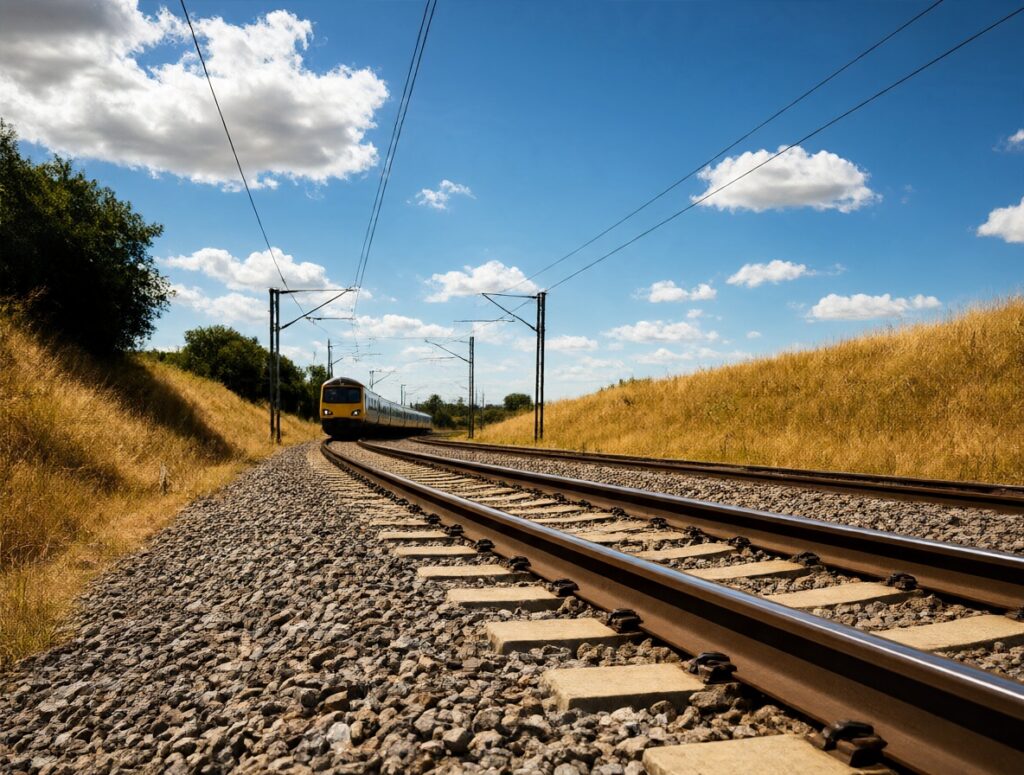
Why does sunshine slow the railway down?
Because the railway itself reacts to heat. Steel rails expand, overhead wires can sag, signalling equipment gets hotter and prolonged dry weather can affect the ground supporting the track. Slower running is often a precaution rather than evidence that something has already broken.
Myth: A hot-weather speed restriction means the track has already buckled.
Reality: It is often preventative. Trains are slowed because conditions increase the risk of a problem developing.
Hot weather and railways are not especially good friends. When temperatures rise, steel rails expand, overhead power lines can sag, signalling equipment can overheat and long dry spells can affect the ground underneath the track. That can mean slower trains, temporary speed restrictions and, occasionally, cancellations.
So if your train is crawling along on a perfectly sunny afternoon, there may be rather more going on than it looks.
Why do railway tracks get so hot?
Railway tracks are made from steel, and steel absorbs heat very efficiently. Network Rail says rails in direct sunshine can become up to around 20°C hotter than the surrounding air. That means an air temperature of 30°C can potentially push rail temperatures towards 50°C.
As steel gets hotter, it expands. The railway is designed to cope with a certain amount of that movement, but during extreme heat the forces inside the track can become much greater. If a vulnerable section of rail cannot expand safely, it can start to move out of alignment. That is when buckling becomes a risk.
What is a buckled rail?
A buckled rail is a section of track that has been pushed out of its normal alignment by heat-related expansion. That is obviously not something you want a train travelling across at full speed.
If monitoring suggests a section of track is becoming vulnerable, Network Rail can introduce a temporary speed restriction. Slower trains place less force on the track, reducing the chance of a buckle developing. If a rail actually buckles, the line may need to close while engineers repair it.
Often, it is preventative. The train is being slowed down because the infrastructure is getting hot enough that running at normal speed would increase the risk of a bigger problem.
Why do trains run more slowly in hot weather?
Temporary speed restrictions are one of the main reasons journeys can gradually pick up delays during very hot weather. A restriction on one short section of railway might only add a few minutes, but those minutes can accumulate.
A train arriving late at the next station may miss its usual path through a busy junction. Another train may then have to wait. A platform might still be occupied when the next service arrives. Eventually, a relatively small restriction can have an effect much further along the railway. Why one delayed train makes lots of other trains late explains how that knock-on effect builds.
Why are some railway tracks painted white?
If you have ever spotted a stretch of railway that looks as though someone has attacked it with a tin of white paint, there is a good reason. That is pretty much exactly what has happened.
White surfaces reflect more sunlight than dark ones, so painting vulnerable sections of rail white reduces the amount of heat they absorb. Network Rail says white-painted rails are typically around 5°C to 10°C cooler than untreated rail.
It is mainly used on known hot spots rather than across every mile of track. Which is probably just as well.
What happens to overhead power lines in hot weather?
The rails are not the only part of the railway affected by heat. On electrified routes, many trains collect power from overhead wires using equipment on the roof called a pantograph.
Those wires are also made from metal. As temperatures rise, they expand and can begin to sag. If they sag too much, there is a risk of the pantograph damaging the overhead equipment as the train passes underneath.
To reduce that risk, trains may need to travel more slowly. Modern overhead line systems are generally better at handling temperature changes because they use weights or springs to maintain tension. Older fixed-tension systems are more vulnerable.
Can hot weather affect signalling?
Yes. Some signalling equipment is housed in trackside cabinets containing electronics. During very hot weather, Network Rail says temperatures inside these cabinets can exceed 70°C, increasing the risk of equipment failure.
When signalling equipment fails, trains cannot simply carry on as normal. Signals and train detection systems are fundamental to keeping trains safely separated, so failures can result in delays, slower running or temporary restrictions while engineers investigate the problem.
What does drought have to do with trains?
Long periods of dry weather can remove moisture from the ground supporting the railway. This is particularly important where tracks are built on clay.
Clay can shrink significantly as it dries out. If the ground underneath the railway moves, the track above it can become uneven. Trains may then have to travel more slowly until engineers have inspected or stabilised the affected section.
So sometimes the problem is not actually the heat on the day. It is what several weeks of hot, dry weather have done to the ground.
How does the railway prepare for hot weather?
Quite a lot happens before passengers notice anything. Network Rail monitors forecasts, track temperatures and known vulnerable areas so it can intervene before infrastructure fails.
- Monitoring track temperatures using sensors and trackside equipment.
- Checking vulnerable sections of railway before summer.
- Painting known hot spots white.
- Introducing temporary speed restrictions.
- Adjusting older overhead power equipment.
- Monitoring areas affected by prolonged drought.
The goal is usually not to prevent every delay. It is to prevent a relatively manageable delay becoming a major infrastructure failure.
Why can delays continue after the temperature drops?
Because the railway does not instantly reset itself. Once trains have been slowed, cancelled or moved out of their normal sequence, it can take time for everything to recover.
Trains may be in the wrong place, crews may be displaced, services may have missed planned turnaround times and platforms may be occupied later than expected. Removing the original speed restriction fixes the cause, but not immediately everything that happened because of it.
The recorded effect of those restrictions shows up in the route rankings: our most delayed train routes page ranks GB routes by the average delay actually observed in the latest complete 30-day window.
What should you do if you are travelling in very hot weather?
If exceptionally hot weather is forecast, check your journey before leaving, allow extra time and carry water. If restrictions are being introduced, your train may still run but take slightly longer than usual. You can see what operators are currently reporting in our live disruption report.
If you see a delay reason referring to hot weather or a speed restriction, it is worth remembering that slower running is often preventative. Our guide to why UK trains run late covers the full range of causes. A few extra minutes is generally preferable to a buckled rail or damaged overhead wire closing the railway completely.
The short version
Heat can expand rails, affect overhead wires and signalling, and dry out the ground beneath the track. Speed restrictions help trains pass affected sections safely.
Sources and further reading
- Network Rail: Hot weather and the railway
- Network Rail: Buckled rail and summer heat
- Network Rail: Why rails are painted white in summer
- Network Rail: Soil moisture deficit on the railway
- National Rail: Travelling in hot weather
Keep reading
- Why are UK trains late? The main causes of rail delays explainedThe main causes of UK rail delay in plain English, from red signals to…
- Train delay compensation and refunds: the complete guideDelay Repay thresholds, Condition 30 refunds and every claim route: how to get money…
- Why do trains sometimes skip stops?Why trains skip scheduled stations during disruption, how service recovery works, and what to…
Part of the guide: Train delay compensation and refunds
Was this guide useful?
Tell us honestly. It helps us decide which guides to improve next.
Thank you, that has been recorded.
Be first on board
The Live Trains UK app is on the way. Join the launch list and be first to track a live train from your phone. One email the day it ships, then your address is deleted.
You are on the list. One email at launch, then your address is deleted.