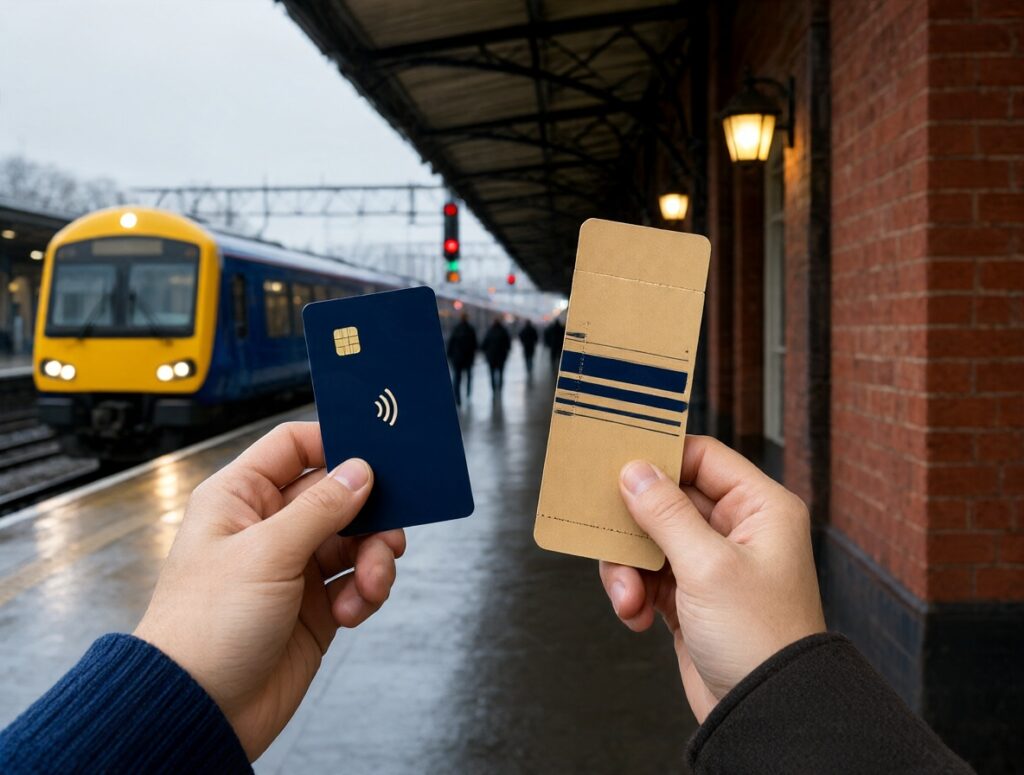
You get to the station. The barriers accept contactless. So should you just tap your bank card and go, or buy a train ticket first? The answer is simple but not especially satisfying: it depends.
Quick answer
For many straightforward adult journeys in the contactless area, pay as you go costs the same as an adult ticket bought on the day. But it is not automatically the cheapest option. Advance fares, Railcards, child fares, Season Tickets and Flexi Seasons can all beat contactless in the right circumstances.
When is contactless likely to be a good deal?
National Rail says that in most cases pay as you go with contactless costs the same as an adult ticket bought on the day. You tap in, which National Rail writes as touch in, at the start, and tap out with the same card or device at the end, and the system calculates the appropriate adult pay-as-you-go fare.
That makes it particularly useful for spontaneous adult journeys where you value flexibility and do not have a discount to apply.
So why can a normal ticket be cheaper?
Contactless does not search every rail fare that could apply to your journey. A conventional ticket can instead take advantage of things such as Advance fares, Railcard discounts, child fares, Season Tickets and Flexi Season Tickets.
| Your situation | Usually worth checking |
|---|---|
| Simple adult journey today | Contactless |
| Several journeys into or within London | Contactless, because capping may help |
| You have a Railcard | Train ticket |
| You are travelling with children | Train ticket or eligible Oyster concession |
| You can book ahead | Advance ticket |
| You make the same journey regularly | Season or Flexi Season |
| Your journey is outside the contactless area | Train ticket |
The biggest difference: Railcards
Railcard discounts do not currently apply when you pay as you go with an ordinary contactless bank card or device.
Our guide to how Railcards work explains the eligibility rules. For the full picture, our complete guide to train tickets and fares pulls everything together.
Illustrative example
If an adult fare were £30, tapping a bank card could mean paying £30. An eligible ticket with a one-third Railcard discount could be around £20, subject to the Railcard’s conditions and any minimum fare.
Some eligible Railcards can be linked to Oyster instead, although not every Railcard qualifies. National Rail currently excludes the 16-17 Saver, Two Together, Family & Friends and Network Railcards from Oyster pay-as-you-go Railcard discounts.
Contactless can win because of capping
If you make several qualifying journeys into or within London, contactless can apply daily and Monday-to-Sunday caps automatically.
The daily contactless cap runs from 04:30 to 04:29 the next day. Weekly capping runs Monday to Sunday, not as a rolling seven-day period.
For maximum weekly benefit, National Rail advises using the same contactless card or device from Monday onwards.
Important limitation
National Rail says capping is not available for pay-as-you-go contactless journeys that do not include travel in London Zones 1 to 9.
Use the same card or device
For capping and correct journey matching, use the same payment method throughout. A physical debit card and a phone wallet linked to the same bank account are treated as different contactless devices.
What about a One Day Travelcard?
Do not assume a Travelcard is automatically cheaper. National Rail says that in some cases daily capping on contactless or Oyster can work out cheaper than a One Day Travelcard.
The better option depends on the zones used, where the National Rail journey starts, when you travel and whether you qualify for discounts.
Advance tickets can change the answer
Advance tickets are tied to a specific train and sold in limited numbers, but can be substantially cheaper than a walk-up adult fare.
National Rail says many operators now sell Advance tickets on the day of travel, in some cases up to around 10 minutes before departure. So even if you are already on your way to the station, it can still be worth checking before automatically tapping in.
Children should not simply tap an adult bank card
Pay as you go with contactless charges adult fares. Child and concessionary discounts are not currently available on ordinary contactless.
Children may instead be eligible for child tickets or Oyster concessions, depending on the journey.
What if you travel regularly?
Regular commuters should compare contactless with Season Tickets and Flexi Seasons. National Rail says a traditional Season Ticket can offer better value for repeated travel between the same two stations.
A Flexi Season currently gives 8 days of travel within a 28-day period on eligible routes, with no need to choose the days in advance.
Peak and off-peak still matter
Contactless fares can vary by when you touch in. National Rail’s current contactless cap guidance lists the standard morning peak as 06:30 to 09:30 Monday to Friday. Evening peak rules include 16:00 to 19:00 for certain journeys from or via London Zones 1 to 9. Outside London, evening peak arrangements can vary by operator.
Is contactless available everywhere?
No. Pay as you go with contactless covers London and an expanding area of the South East rather than the whole National Rail network.
The network expanded again on 8 March 2026, when 20 more stations were added, including Chelmsford, Bishop’s Stortford, Stansted Airport and Southend Victoria.
Before comparing prices, first check that contactless pay as you go is valid for your entire journey. Our guide to contactless on National Rail explains where pay as you go is accepted.
One contactless card per passenger
One contactless card or device cannot pay for several passengers. Each person using contactless pay as you go needs a separate card or device.
What if you forget to touch out?
If the system cannot establish a complete journey because you miss a touch in or touch out, you can be charged a maximum fare. TfL provides a process for checking and correcting journey history where appropriate.
What about First Class?
Pay as you go with contactless is Standard Class only. If you want to travel First Class, you need an appropriate First Class ticket.
Contactless vs ticket: the 20-second decision
Use contactless when:
You are an adult travelling wholly within the contactless area, have no discount to apply, want flexibility, and especially if you may make several qualifying journeys into or within London.
Check a normal ticket first when:
You have a Railcard, are buying for a child, can book an Advance fare, travel the same route regularly, want First Class or are travelling outside the contactless area.
Which is actually cheaper?
There is no universal winner.
Contactless can be better value because daily or weekly capping may limit your total cost and you only pay for the journeys you actually make.
A conventional ticket can be cheaper because Advance fares, Railcards, child discounts, Seasons, Flexi Seasons and other valid discounts may apply.
Questions people search for
Questions people search for
Is contactless cheaper than buying a train ticket?
Often, but not always. For a straightforward adult pay as you go journey in the contactless area, contactless costs about the same as an adult ticket bought on the day. A ticket can be cheaper if you connect to an Advance fare, hold a Railcard, are travelling with children, or would otherwise use a Season or Flexi Season.
Is it cheaper to tap in or buy a ticket?
Tapping in is quick, and for a simple adult journey it usually costs the same as an on-the-day adult ticket, so it is rarely worse. But buying a ticket can beat it when a discount applies, because Railcard and child discounts do not follow the card you tap in with.
Is tap in tap out cheaper?
Tapping in and tapping out does not get you a lower fare on its own. The system charges the appropriate adult pay as you go fare for the journey. The saving appears when capping kicks in, for example if you make several journeys in London in one day and your taps total more than the daily cap.
Sources
- National Rail: Pay As You Go with Contactless
- National Rail: Contactless caps
- National Rail: Oyster, Contactless and Travelcards
- National Rail: Advance Tickets
- National Rail: Season Tickets
- National Rail: Flexi Season Tickets
Fares, capping rules and the contactless area can change. Check the current fare and validity for your journey before travelling.
Keep reading
- What actually decides the price of a train ticket?What decides UK ticket prices: Advance availability, Off-Peak rules, Anytime flexibility, Railcards and split…
- Do under-5s need a train ticket?When under-5s travel free in the UK, when a child ticket makes sense, seat…
- Why does splitting a train ticket sometimes make it cheaper?How split ticketing works, when two tickets for one journey are valid, and why…
Part of the guide: Train tickets and fares
Was this guide useful?
Tell us honestly. It helps us decide which guides to improve next.
Thank you, that has been recorded.
Be first on board
The Live Trains UK app is on the way. Join the launch list and be first to track a live train from your phone. One email the day it ships, then your address is deleted.
You are on the list. One email at launch, then your address is deleted.