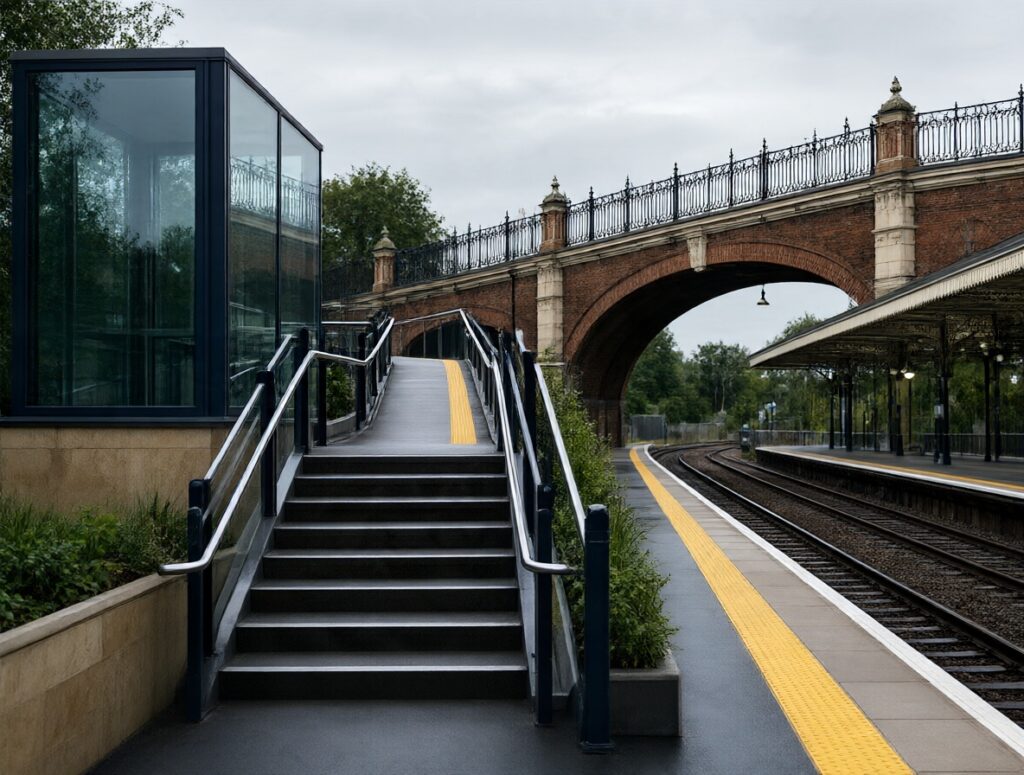
A station can be described as step-free and still not be effortless to use.
There may be lifts. There may be ramps. You might be able to reach every platform without stairs.
But that does not automatically mean the route is short, the lifts are working, the platform is level with the train, or that you will not need a boarding ramp.
Quick answer
Step-free access usually means you can reach the relevant platform without using stairs. But the detail matters. Some stations are fully step-free to every platform, some only have step-free access to certain platforms or via a longer route, and some have no step-free platform access at all.
There are actually three official categories
The Office of Rail and Road requires operators to classify stations using a standard A to C system.
| Category | What it means |
|---|---|
| A | Step-free access to all platforms, at all times trains are running, via level access, lifts or suitable ramps. |
| B | Some degree of step-free access, but the station does not meet the Category A standard. Access may be limited to some platforms, one direction, a longer route, or involve steeper ramps. |
| C | No step-free access to any platform. |
ORR requires these classifications to be used consistently in public-facing station accessibility information.
Category A sounds simple. Is it?
Category A is the strongest classification. It means the station has step-free access to and between all platforms whenever trains are running, using level access, lifts or compliant ramps.
But even a Category A station may still involve a significant walk or rely on lifts. It also does not, by itself, tell you what the gap or height difference is between the platform and the train.
Category B is where the detail really matters
Category B covers a wide range of stations.
At one station, every platform might technically be step-free but require a long route outside the station. At another, only one platform may be accessible. Somewhere else, the route might use a long or steep ramp.
So if you see Category B, do not stop at the letter.
Read the station-specific accessibility notes before travelling.
National Rail station pages show this detail, including which platforms are accessible, staffing arrangements, help points, ramps, toilets and other facilities.
Step-free does not necessarily mean level boarding
This is probably the most important distinction.
You can have a completely step-free route from the street to the platform and still encounter a gap or height difference between the platform and the train.
That means some passengers may still need a boarding ramp or staff assistance even at a step-free station.
ORR guidance requires train operators to provide suitable ramps at staffed stations, either at the station or on board the train, to help passengers board or leave trains. Where assistance is booked at an unstaffed station, the operator must make arrangements for a member of staff with a ramp where needed.
Think of the journey as three separate accessibility questions
1. Can I get into the station without stairs?
2. Can I get from the entrance to the correct platform without stairs?
3. Can I get from the platform onto the train?
A single “step-free” label cannot always answer all three.
What about lifts?
Many step-free stations rely on lifts to reach platforms.
That means an unexpected lift fault can temporarily turn a normally accessible route into an inaccessible one.
This is not a theoretical edge case. ORR recorded 1,403 passenger lifts at 540 Network Rail-owned stations as of 31 March 2026, with thousands of lift faults recorded across the preceding six rail periods.
So if your journey depends on a particular lift, it is worth checking the station’s live accessibility information before setting off.
Why can a step-free route be much longer?
Older stations were not designed around modern accessibility standards.
A station might have stairs directly between platforms but require step-free passengers to:
- use a lift and footbridge
- leave the station and use a road route
- enter through a different station entrance
- travel via a ramped subway
That does not necessarily mean the station is inaccessible. It does mean you may need more time.
Can step-free access be available only at certain times?
Yes.
Some stations depend on staff-controlled crossings, locked routes, lifts or other arrangements that are only available during particular hours.
For example, National Rail station information can list a station as Category B and explain that step-free access to certain platforms is only available during staffed periods.
This is why the detail on the station page matters more than the category alone.
What if I use a wheelchair?
Check both the station and the train. Our guide to travelling by train with a wheelchair covers the whole journey.
A station may have step-free platform access, but wheelchair boarding can still depend on:
- the platform-to-train gap
- the height difference
- whether a boarding ramp is needed
- the type of train operating the service
- whether an accessible route is available at your destination
ORR also requires operators to publish information about the accessibility of the trains they normally use, including wheelchair provision.
Passenger Assist can bridge some of those gaps
Passenger Assist is free and is available to passengers who need help because of disability, temporary impairment or age.
Assistance can include help navigating the station, changing platforms, boarding or leaving the train, using a ramp, and finding your seat.
National Rail currently accepts Passenger Assist booking requests up to 2 hours before the journey is due to start.
Read our full guide to how Passenger Assist works.
You can also request assistance without booking in advance using Turn Up and Go. At staffed stations, staff will help where they can, although it may take longer if they are dealing with other duties.
Does step-free access mean the station is fully accessible?
No.
Accessibility covers much more than stairs.
Someone might also need:
- tactile paving
- accessible toilets
- induction loops
- working help points
- clear visual and audio information
- accessible ticket facilities
- suitable seating
- staff assistance
A station can therefore be step-free while still presenting other barriers to some passengers.
And the opposite can also be true
A station without full step-free access may still be usable for some disabled passengers.
Accessibility needs are not identical. Someone who cannot manage long distances may face a different problem from someone who cannot use stairs, and someone with a visual or hearing impairment may need completely different facilities.
That is another reason “accessible station” is too broad a label to be particularly useful on its own.
What should you check before travelling?
- Check the step-free category for your origin, interchange and destination.
- Read the station-specific accessibility notes, especially for Category B stations.
- Check whether lifts or accessible routes are currently unavailable.
- Check whether you will need a boarding ramp.
- Allow extra time if the step-free route is longer than the normal route.
- Use Passenger Assist if you want help with boarding, changing trains or navigating the station.
A useful real-world example
Imagine a station with two platforms.
Platform 1 is directly accessible from the street.
Platform 2 is reached by stairs, but there is also a step-free route that leaves the station, goes along the road and re-enters from the other side.
That station may still have a degree of step-free access, but the practical experience is very different from a station where lifts connect every platform inside the building.
Both might appear “step-free” in a quick search, which is why the category and station notes matter.
What if the accessible route fails?
If disruption to station facilities means your planned accessible journey cannot be made as expected, speak to the train or station operator.
ORR requires operators to maintain Accessible Travel Policies setting out how they will support disabled and older passengers, including circumstances where alternative accessible transport may need to be arranged.
Who pays for step-free access? Access for All
Who pays for step-free access? Access for All
Much of the step-free work at British stations happens through Access for All, a rail accessibility programme that has been running since 2006. It is funded by the Department for Transport and delivered by Network Rail, which installs accessible routes such as lifts, footbridges and ramps at selected stations.
Since 2006 the programme has delivered step-free accessible routes at more than 270 stations. A shorter-term mid-tier strand funds smaller fixes at other stations, including tactile paving, handrails and Harrington humps, which are raised platforms that reduce the gap and step onto the train.
So when a station page tells you step-free access is available, the work behind that line often traces back to this programme. The programme itself is also being reshaped as Great British Railways is established, so the routes stations publish today may evolve in future years.
Step-free access in one minute
Does step-free mean no stairs to the platform?
Yes, for the route described as step-free.
Does it mean every platform is accessible?
Not necessarily. Check whether the station is Category A, B or C.
Does it mean level boarding onto the train?
No.
Could I still need a ramp?
Yes.
Can step-free access depend on lifts or staff?
Yes.
Should I check the individual station page?
Definitely.
What is Access for All?
It is a government-funded rail accessibility programme, running since 2006, that has paid for step-free routes at hundreds of British stations.
Sources
- Office of Rail and Road: Accessible Travel Policy guidance and station accessibility classifications
- Office of Rail and Road: Passengers with disabilities
- Office of Rail and Road: Accessible Travel Policies
- ORR Data Portal: Passenger lifts at stations
- National Rail: Passenger Assist
- Department for Transport: Access for All programme collection
- GOV.UK: Railway stations awarded Access for All accessibility funding
- House of Commons Library: Rail station accessibility and the Access for All programme
Station facilities can change temporarily because of engineering work, lift faults or staffing arrangements. Check current station information before travelling if your journey depends on step-free access.
Keep reading
- How do you travel by train with a wheelchair?Station access, wheelchair spaces, ramps and Passenger Assist: a practical guide to travelling by…
- How does Passenger Assist work on UK trains?How to book free Passenger Assist, how Turn Up and Go works, and what…
Was this guide useful?
Tell us honestly. It helps us decide which guides to improve next.
Thank you, that has been recorded.
Be first on board
The Live Trains UK app is on the way. Join the launch list and be first to track a live train from your phone. One email the day it ships, then your address is deleted.
You are on the list. One email at launch, then your address is deleted.