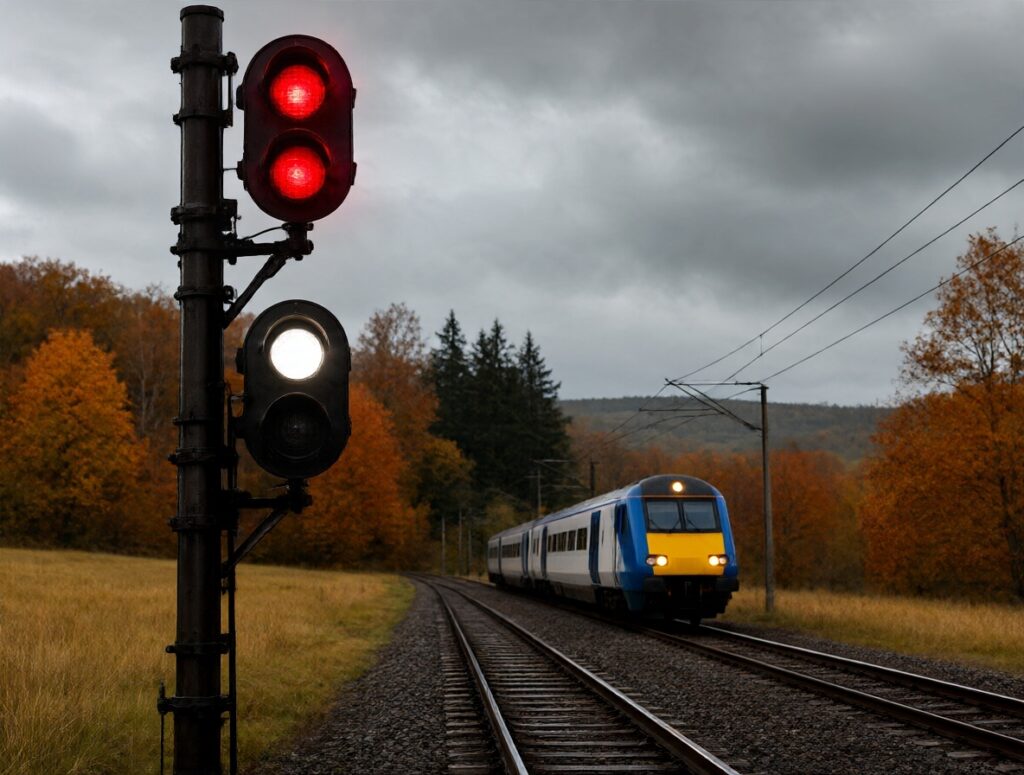
You are nearly there. The station is visible, the train slows, then stops, and the announcement arrives: “We’re being held at a red signal.” It can feel vague, but a red signal is doing something very specific: keeping train movements safely controlled.
Quick answer
A train may be held because another train is ahead, a platform or junction is not yet available, the route has not yet been set, or signalling staff need to confirm that it is safe for the train to proceed.
Delays of this kind accumulate along a route, and over a full month you can see the result: our most delayed train routes page ranks GB routes by the average delay actually recorded in the latest complete 30-day window.
What does a red railway signal mean?
In conventional lineside signalling, a red signal means stop unless authorised to proceed. Signalling systems are fundamental to safe railway operation because they keep trains safely spaced and prevent conflicting movements.
Traditional railway signalling commonly divides the route into controlled sections so that trains are not allowed into the same protected area at the same time. Newer digital systems can work differently, but the safety principle remains the same: a train only receives authority to move when the route is safe.
Why can’t the driver just move forward slowly?
Because the driver cannot simply decide that the track ahead looks clear. Passing a stop signal without authority is known as a Signal Passed at Danger, or SPAD.
The railway also uses train protection systems such as TPWS, which can automatically apply the brakes in certain circumstances if a train exceeds safe movement limits, including approaching a signal too quickly or passing a signal at danger.
The railway ahead might look empty
A signal is not necessarily protecting only the short stretch of track visible from your window. It may be protecting another train further ahead, a junction, a platform, a set of points or another route that conflicts with yours.
Think of it this way
The railway is looking much further ahead than you can from your seat.
A simple three-train example
Imagine Train A is still standing at Platform 2. Train B is approaching that platform. Your train, Train C, is behind Train B.
Even if Train B is out of sight, your signal may remain red until enough safe space becomes available. That can produce the familiar pattern of moving briefly, stopping, then moving again.
Why does this happen so often outside stations?
Busy stations concentrate lots of train movements into a small area. Trains may be arriving, departing, crossing between tracks, reversing direction or trying to use the same platform.
A train can therefore be physically close to the station but still unable to enter because the route into it is not yet available.
Red signals and junctions
Junctions are another common reason for waiting. Two trains may need to cross or merge onto the same piece of railway, and the signalling system prevents conflicting routes from being authorised at the same time.
| Situation | Why your train may wait |
|---|---|
| Another train ahead | The protected section is still occupied |
| Busy junction | Another route has been authorised first |
| Platform unavailable | A train is still occupying it or the route into it is not ready |
| Signalling fault | More restrictive procedures may be needed before movement can be authorised |
Can another late train cause yours to get a red signal?
Yes. This is one way delay spreads across the network: why one late train makes lots of others late follows the whole chain.
If a train that should already have cleared a junction is running late, your on-time train may reach the same area while that route is still occupied. Your train then has to wait, and another service can subsequently catch up behind yours.
Why not just let the on-time train go first?
Sometimes controllers can change the order of trains, but it is not always as simple as giving priority to whichever service is currently on time.
They may also need to consider routes already set, platform availability, train type and speed, where each service needs to go next, and the wider knock-on effects of changing the order.
What happens when signalling equipment fails?
Signalling faults can lead to more restrictive operation while staff establish that train movements can be made safely. Depending on the fault and location, trains may be held, run more slowly or operate under special procedures.
National Rail describes signals as equipment that tells drivers when it is safe to continue ahead, which is why signalling faults can disrupt services even when there is no physical obstruction on the track. If a signalling problem is holding things up, our live disruption report shows what operators are currently reporting. Our guide to why UK trains run late explains the wider picture.
What if the railway isn’t sure where a train is?
That can also result in red signals. Network Rail gives an autumn example where leaf contamination interferes with the track equipment used to establish train position. If the railway cannot be certain exactly where a train is, trains behind can be held until its location is established and safe separation is confirmed.
So sometimes a red signal does not mean, “There is definitely a train immediately ahead.” It means, “The railway has not yet confirmed that it is safe for you to proceed.”
Could you get a red signal even if the platform is empty?
Yes. An empty platform does not automatically mean the route into it is available.
Another train may be crossing the approach, points may not yet be set, the route beyond the platform may still be occupied, or a conflicting movement may currently have priority.
How does the railway protect against passing a red signal?
Britain uses signalling alongside train protection systems. TPWS is widely used on the mainline railway and can intervene by applying the brakes in defined circumstances.
ORR says the introduction of TPWS substantially reduced SPAD risk. Some routes also use more advanced systems such as ETCS.
A red signal does not automatically mean something has gone wrong
Stopping at a red signal can be completely normal railway operation.
Normal: another train is legitimately using the junction ahead.
Knock-on delay: a late-running train has not yet cleared the route.
Disruption: a signalling fault means trains must be controlled more restrictively.
From inside the carriage, all three can look almost identical.
Why does the signal suddenly change?
Because the condition preventing your train from moving has cleared. The train ahead may have left the section, a platform may have become available, another train may have cleared a junction, or the correct route may now be authorised.
Red signals in one minute
Why are we stopped?
The railway has not yet authorised the train to continue.
Does it always mean another train is directly ahead?
No.
Can the driver ignore it if the track looks clear?
No.
Can a late train cause ours to be held?
Yes.
Can signalling faults cause delays at red signals?
Yes.
Sources
- Office of Rail and Road: Command, control and signalling
- Office of Rail and Road: Signals passed at danger
- Office of Rail and Road: Train protection systems
- Network Rail: Leaves on the line
- National Rail: Engineering works explained
Keep reading
- Why live train information differs from the timetableTimetables describe what should happen; live feeds report what is happening. Why departure boards…
- Why are UK trains late? The main causes of rail delays explainedThe main causes of UK rail delay in plain English, from red signals to…
- Train delay compensation and refunds: the complete guideDelay Repay thresholds, Condition 30 refunds and every claim route: how to get money…
Part of the guide: Train delay compensation and refunds
Was this guide useful?
Tell us honestly. It helps us decide which guides to improve next.
Thank you, that has been recorded.
Be first on board
The Live Trains UK app is on the way. Join the launch list and be first to track a live train from your phone. One email the day it ships, then your address is deleted.
You are on the list. One email at launch, then your address is deleted.