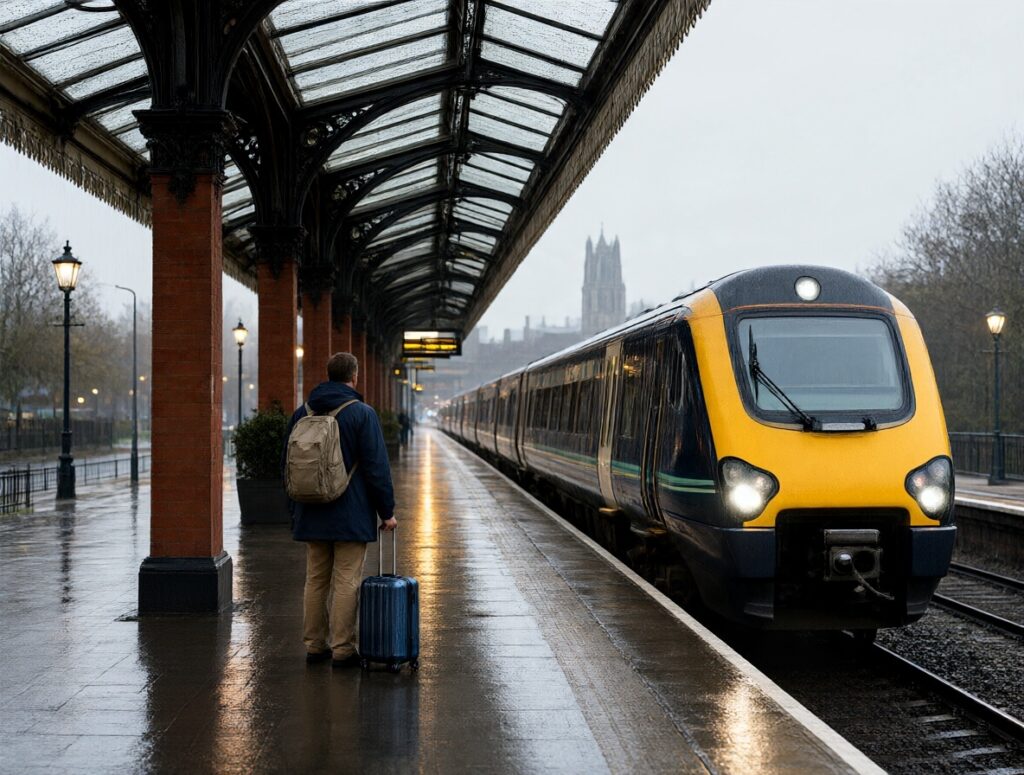
When your train is late there is a reason, and it is usually one of a small number of causes. This guide explains the main ones in plain English, how one problem spreads across the timetable, and where to go next when it is your journey that slips.
“The train sat at a red signal because the driver lost track of time.” A held train is being kept apart from the one in front; the hold usually clears once the line ahead moves.
The main causes, in one place
1. Red signals
Signals protect the railway; a train held at red waits until the line ahead is clear
2. Weather
Heat, rain, wind and snow each restrict running in different ways
3. Knock-on delays
One late train makes many others late as trains and crews cascade
4. Busy railways
Trains queue for platforms and junctions when the network has no slack
Why do trains get held at red signals?
Signals exist to keep trains apart. A train held at a red signal is being protected by the system, not ignored by it, and the hold usually clears once the train ahead has moved on. When a signal itself develops a fault, or a train in front cannot move quickly, the standing time builds up. Our guide to why trains get held at red signals goes deeper, including how a signalling fault in one place can delay trains nowhere near the fault.
Why does the weather slow trains down?
Hot weather is the clearest example: steel rails expand in heat, so operators impose speed restrictions to reduce the strain and reduce the risk of a buckle. You will often see hot-weather speed restrictions in summer, and your train may sit in the open for a few minutes longer than usual as a result. Why hot weather affects trains explains the mechanics and what operators publish about it.
How one late train makes many late
Railways rely on equipment and crews turning up in the right order. A train that finishes late arrives at its next job late; the crew who were due to work it may need a fresh train instead; the platform slot moves, and every following service inherits the shuffle. To protect the wider timetable, operators sometimes take recovery decisions such as skipping stops to claw time back.
Two guides cover this in detail: how one delayed train makes lots of others late and why trains sometimes skip stops.
What if the train is simply late with nothing visibly wrong?
Trains sometimes wait outside a busy station because the platform is still occupied, or because a junction ahead is congested. Nothing looks wrong from a carriage window, but the line has run out of slack. Our guide to why trains wait outside a station explains those quiet minutes.
What to do when your train is late
- Still travelling? Missed connections are usually protected: what happens when you miss a connection.
- Arrived late? Delay Repay is likely relevant: how Delay Repay works.
- Decided not to travel? The refund route may apply: refunds after disruption.
- Not sure which one? The complete guide to train delay compensation and refunds sorts it out.
For what operators are reporting on the railway right now, check the live disruption report.
The detailed guides
- Why do trains get held at red signals?
- Why does hot weather affect trains?
- Why does one delayed train make lots of other trains late?
- Why do trains sometimes skip stops?
- Why do trains wait outside a station?
- What actually happens when you miss a connection?
- What is Delay Repay and how does it work?
- Can you claim compensation if your train is cancelled?
- Can you get a refund if you decide not to travel after disruption?
- Delay Repay vs a ticket refund: what is the difference?
The short version
Trains run late for a handful of reasons: signals and infrastructure, weather restrictions, congestion on the busiest parts of the network, and the knock-on effect that turns one delayed train into a whole evening of late arrivals. Each of our guides lets you dig into one cause, and every late journey has a compensation or refund route if it costs you.
Sources
- Network Rail: Knock-on delays
- Network Rail: How we keep you updated when there is a delay
- National Rail: Changing trains
- National Rail: Compensation and refunds
Delay arrangements vary by operator and can change. Check the live information published for your journey and your operator’s own guidance.
Keep reading
- Delay Repay vs a ticket refund: what is the difference?Delay Repay or train ticket refund? The difference depends on whether you travelled and…
- What actually happens when you miss a connection?Missed your train connection in Britain? Understand the difference between a delayed first train,…
- Refund if you decide not to travel after disruption?If disruption stops you travelling, Condition 30 gives a no-fee refund on unused tickets.…
Part of the guide: Train delay compensation and refunds
Was this guide useful?
Tell us honestly. It helps us decide which guides to improve next.
Thank you, that has been recorded.
Be first on board
The Live Trains UK app is on the way. Join the launch list and be first to track a live train from your phone. One email the day it ships, then your address is deleted.
You are on the list. One email at launch, then your address is deleted.