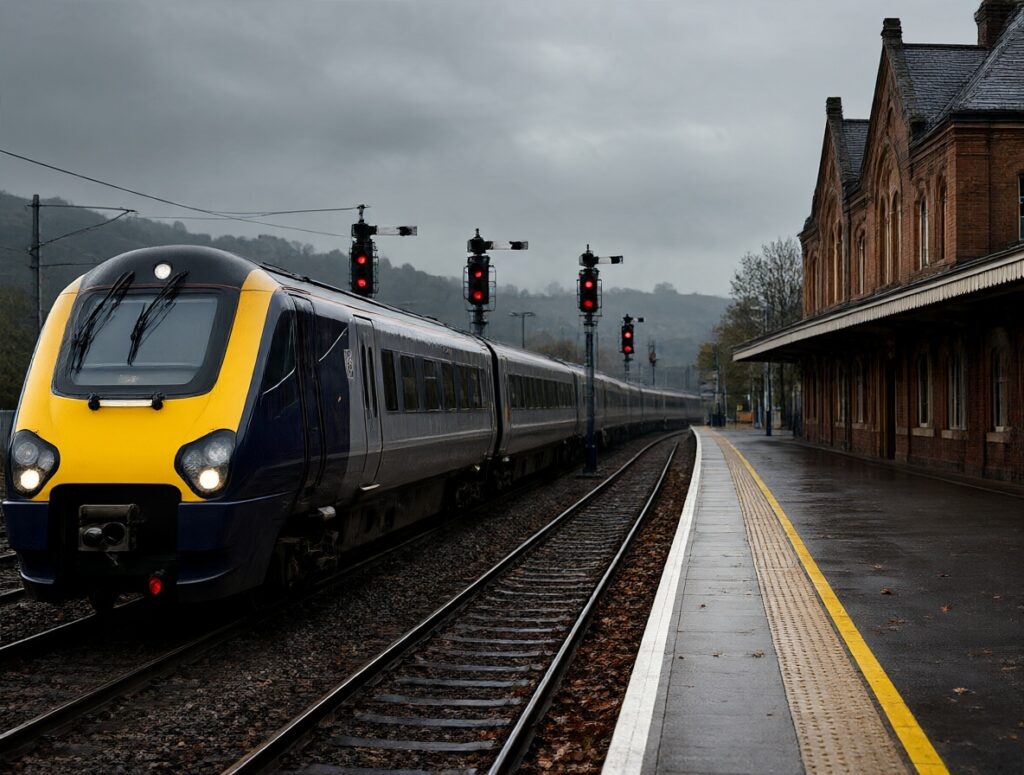
Why are we stopped when the station is right there?
Usually because the route into the station is not available yet. A platform may still be occupied, another train may be crossing the junction ahead, or your train may be waiting at a red signal until the next section of railway is safely clear.
An empty platform does not always mean your train can use it. The track layout may not provide a route to that platform, or moving your train there could conflict with another service already approaching the station.
You’re nearly there. You can see the platforms. You may even be able to see people standing on them. Your train slows to walking pace, stops completely and then… nothing.
A couple of minutes pass. The inevitable announcement follows: “We’re currently being held outside the station.”
It can feel particularly baffling when the station is only a few hundred metres away. But in most cases, the train isn’t waiting because somebody has forgotten it exists. It is waiting because there isn’t yet a safe route into the station.
And there are several reasons that can happen.
The platform might still be occupied
Probably the simplest explanation is that another train is still using the platform your train is due to enter.
Railway timetables have to allow a minimum amount of time between trains using the same platform. Network Rail explains that railway capacity depends on safe separation between services and the time needed for trains to clear routes and platforms.
Normally, everything lines up neatly. One train arrives, passengers get off and on, the train leaves, the route resets and the next train comes in.
The trouble starts when the first train is late. Perhaps boarding takes longer than expected. Perhaps that train itself is waiting for a signal. Perhaps there has been disruption elsewhere.
Your train can then catch it up remarkably quickly. And unlike cars arriving at a busy supermarket, trains cannot simply squeeze into whatever space happens to be available.
Your train may be sitting at a red signal
The railway signalling system exists partly to make sure trains remain safely separated.
Network Rail describes signalling as essentially the railway’s traffic-light system. Signals tell drivers whether it is safe to proceed, while the wider signalling system keeps track of where trains are and controls which routes they can take.
So when your train stops just outside a station, there is often quite literally a red signal in front of it. Our guide to why trains get held at red signals goes into that in more depth.
That doesn’t necessarily mean anything has gone wrong.
- another train is occupying the platform
- another train is crossing the route at a junction
- the route into your platform has not yet been set
- the section of railway ahead is still occupied
Once the route becomes available and the signalling system confirms it is safe, the train can move.
This also explains why a driver cannot simply creep forwards because the platform “looks clear”. What matters is whether the signalling system says the route is safe, not whether it appears clear from the passenger window.
A junction can be the real culprit
Large stations often have several railway lines converging immediately outside them. That creates what is effectively a series of railway intersections.
A train entering the station from one direction may need to cross the path of another train leaving in a completely different direction. Points in the track are used to direct trains onto the correct routes, and those movements have to be safely coordinated by the signalling system.
Sometimes your train therefore has an empty platform waiting for it but cannot actually reach that platform yet.
Another train has been given the route first. Once it clears the junction, the points can be changed, the route set for your train and the signal cleared.
This is one of those situations where staring intensely at the apparently empty platform sadly does not speed things up.
Busy stations have very little spare room
Britain’s busiest parts of the railway are genuinely busy.
Network Rail says some critical sections operate close to full capacity at peak times, meaning there may be very little spare space in the timetable to absorb disruption.
Stations themselves can also become bottlenecks. A bottleneck is simply part of the railway where infrastructure such as tracks, signals, junctions or platforms limits how many trains can move through the area.
That means a small delay elsewhere can eventually produce a queue outside a station.
Imagine trains are scheduled to arrive every few minutes. One train loses four minutes. The train behind catches it. Another service needs to cross the same junction. A platform remains occupied slightly longer than planned.
Very quickly, several trains can end up wanting the same piece of railway at roughly the same time.
There isn’t a railway equivalent of opening another checkout.
Why can’t they just use another platform?
Sometimes they can. In fact, station controllers sometimes change a train’s platform precisely because another train is delayed.
But changing platforms isn’t always possible.
- It may already have another train booked into it.
- It may be inaccessible from the track your train is using.
- It may be too short for the train.
- Using it may conflict with another route through the station.
- It may be needed by another service shortly afterwards.
So although a station may appear to have plenty of empty platforms, they are not necessarily interchangeable. Railway geography can be surprisingly restrictive.
Why does the train sometimes move a few metres and stop again?
Because the railway ahead can become available in stages.
The signal controlling one section may clear while the next signal remains restrictive. Alternatively, the train may be allowed to move closer to the station while it waits for the final route onto the platform.
Signalling divides the railway into controlled sections so that trains can be kept safely apart. Train-detection systems tell the signalling system whether sections of railway are occupied.
So that slightly irritating sequence of move… stop… move… stop… can simply be the train progressing through the available sections as the traffic ahead clears.
Could there actually be a signalling problem?
Yes, although a red signal doesn’t automatically mean there is one.
When parts of the signalling system fail, they are generally designed to fail safely. A fault can result in signals remaining red until the railway can confirm it is safe for a train to proceed.
A train waiting outside a station could therefore occasionally be caused by a genuine signal, points or train-detection failure.
But if the announcement simply says you’re “waiting for a platform” or “waiting for a signal”, it may just be normal railway traffic management rather than broken infrastructure.
Why does a two-minute wait sometimes become a much bigger delay?
Because your train doesn’t operate in isolation.
Once it loses its original position in the timetable, other trains may be using the junctions, tracks and platforms it was supposed to use next. That creates the possibility of a knock-on delay.
Busy routes can have very little spare capacity to absorb disruption, while delayed trains can also leave rolling stock and crews in the wrong places later in the day. Why one delayed train makes lots of others late explains the mechanics.
Over a complete 30-day window, our station performance page shows how reliably recorded train services called at each GB station.
So the first two-minute wait can occasionally become another minute approaching a junction, a slightly longer dwell later, and suddenly your train is eight minutes late.
Railway delays have an annoying talent for compound interest.
Why doesn’t the station just hold the other train?
Because that can make things worse.
Holding one train to help another may inconvenience everybody travelling on the train being held, potentially cause passengers further along the route to miss their connections, and affect yet more services behind it.
Railway controllers therefore have to think about the whole network, not just the particular train currently sitting outside the station.
Sometimes the least disruptive option overall is unfortunately to make your train wait for a couple of minutes.
Is waiting outside a station dangerous?
Under normal operation, no. Quite the opposite.
The train is normally stopped because the signalling system is preventing it from entering a section of railway that isn’t yet available.
If you are delayed between stations, remain onboard and follow announcements rather than attempting to leave the train. Other trains may still be moving in the area and railway tracks are hazardous environments.
The frustrating wait is therefore usually the railway doing exactly what it is designed to do.
The short version
Your train is usually waiting for a clear platform, junction or route. A red signal may hold it until movement is safe; sometimes a signalling or points fault is responsible.
Sources and further reading
- Network Rail: The timetable
- Network Rail: Signals explained
- Network Rail: Signals and points failure
- Network Rail: Knock-on delays
- Network Rail: Track circuits explained
- National Rail: Changing trains
Keep reading
- Train delay compensation and refunds: the complete guideDelay Repay thresholds, Condition 30 refunds and every claim route: how to get money…
- Why do trains sometimes skip stops?Why trains skip scheduled stations during disruption, how service recovery works, and what to…
- Delay Repay vs a ticket refund: what is the difference?Delay Repay or train ticket refund? The difference depends on whether you travelled and…
Part of the guide: Train delay compensation and refunds
Was this guide useful?
Tell us honestly. It helps us decide which guides to improve next.
Thank you, that has been recorded.
Be first on board
The Live Trains UK app is on the way. Join the launch list and be first to track a live train from your phone. One email the day it ships, then your address is deleted.
You are on the list. One email at launch, then your address is deleted.