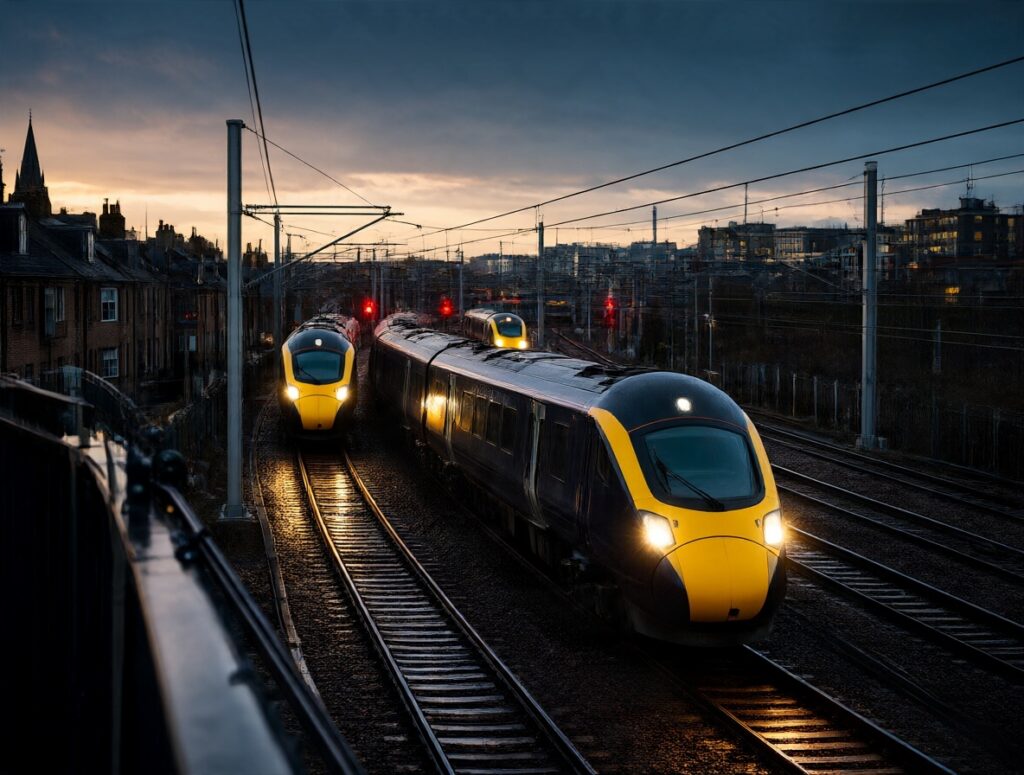
A train can be delayed by five minutes and somehow leave a trail of late trains behind it for hours.
The railway has a name for the indirect delay that follows: reactionary delay. Passengers are more likely to hear it described as knock-on delay.
Quick answer
Britain’s railway is a shared, tightly timed network. When one train is late, it can reach junctions, platforms and busy stretches of track at the wrong time. Other trains then wait, miss their own planned paths, and pass the delay onwards. The original problem may be fixed quickly while the timetable takes much longer to recover.
Direct delay vs reactionary delay
Railway delay attribution distinguishes between delay caused directly by an incident and delay that happens indirectly because something was already late.
| Type | What it means |
|---|---|
| Direct or primary delay | A train is delayed by the original incident itself. |
| Reactionary delay | A train is delayed because of an earlier delay to the same train or another train. |
ORR’s delay-attribution material defines reactionary delay in essentially those terms, while Network Rail uses the more passenger-friendly phrase “knock-on delays”.
A five-minute delay can arrive at the worst possible moment
Imagine Train A should pass a junction at 08:30. Train B is timetabled across the same junction at 08:34. Train A becomes five minutes late.
08:30 Train A should clear the junction.
08:34 Train B should use it.
08:35 Late Train A is still in the way.
08:36+ Train B is now late too.
Train B may then reach its next junction or platform late, delaying Train C. That is how a local problem starts travelling across the timetable.
Why is the railway so sensitive to small delays?
Because busy railways do not have unlimited spare space.
Network Rail says critical parts of the network can run close to 100% capacity at peak times. Trains are threaded through junctions, platforms and shared track in carefully planned sequences.
If one train misses its planned slot, there may not be an empty five-minute gap waiting for it.
Trains cannot simply overtake each other
On a motorway, a faster vehicle can often pass a slower one. Railways are different.
Trains are constrained by the tracks available, signalling, junction layouts and stopping patterns. A late stopping train can end up in front of a faster service, or a late intercity train can reach a junction after another movement has already been given the route.
That can mean waiting at signals even though nothing is wrong with your own train. See our explainer on why trains get held at red signals.
Platforms are part of the puzzle too
A busy station might have several trains planned to use the same platform one after another. If the first arrives late and leaves late, the second may have nowhere to go.
It can end up waiting outside the station, which then delays the service behind it as well.
Then the train itself is in the wrong place
A passenger train may be scheduled to form another service shortly after reaching its destination. If it arrives late, there may be less time to empty and board passengers, carry out checks, clean the train or prepare it for the next departure.
Network Rail specifically identifies late trains being harder to clean, check and prepare as one reason delays continue to spread.
The crew can be in the wrong place as well
Drivers and onboard crews work planned duties across multiple services. A driver arriving late on one train may be due to take another somewhere else.
Even if that second train is physically ready, it may have to wait for its crew. Network Rail highlights displaced trains, drivers and crews as part of the knock-on effect.
Why can’t a late train just make up the time?
Sometimes a train can recover a little time, but there are limits. Drivers still have to obey speed limits and signals, and station stops still take time.
Timetables are built using detailed timings between stations and junctions, plus allowances needed to make the whole network work together. There is not unlimited recovery time hidden inside every journey.
Why does cancelling a train sometimes help?
It sounds counter-intuitive, but cancelling one service can sometimes stop a much larger chain of delays.
Those cancellations are recorded too: our train cancellations page ranks the routes and stations with the highest observed cancellation rates in the latest complete 30-day window.
Network Rail says controllers may cancel trains, alter stops, divert services or shorten journeys to create capacity and get the service back into the right order. Our guide to why trains sometimes skip stops explains one thing this often looks like in practice. For the wider picture, our guide to why UK trains run late pulls all the causes together.
Uncomfortable truth: a decision that is worst for one individual train can occasionally be better for the wider network if it prevents dozens of later services inheriting the delay.
Why can delays continue after the original fault is fixed?
Because fixing the cause and restoring the timetable are two different jobs.
A fault might be repaired at 10:00, but by then trains are late, platforms are being used out of sequence, crews are displaced and rolling stock is no longer where the timetable expected it to be.
Network Rail says knock-on effects can last for hours on busy routes even after a relatively small incident.
The railway equivalent of a traffic jam
A useful analogy is a busy road where one lane closes for ten minutes. The obstruction may be removed quickly, but the queue does not vanish instantly.
Railways add another complication: trains cannot freely change lanes, and each train and crew may be needed later for another scheduled service.
A knock-on delay in one minute
Original fault delays Train A.
Train A reaches a junction late.
Train B has to wait.
Train B reaches its platform late.
Train C cannot enter the platform.
A crew from Train A is late for Train D.
The original fault is fixed.
The timetable is still untangling itself.
Why don’t controllers always prioritise the on-time train?
Because they are trying to minimise the overall impact, not simply protect one service in isolation.
The best sequence can depend on train speeds, stopping patterns, platform availability, crew duties and what each train is due to do later. Letting one on-time train go first can sometimes delay several others more severely.
What can passengers do?
During serious disruption, check the latest journey information rather than assuming the original timetable will gradually reappear unchanged. Our live disruption report lists the notices operators have published right now. Stopping patterns, platforms and whole services can change as controllers recover the network.
If the disruption makes you sufficiently late, you may also be entitled to compensation. See our guide to Delay Repay.
The key thing to remember
A railway timetable is not a collection of independent trains. It is one enormous shared plan.
When a train misses its place in that plan, it can block a junction, occupy a platform, delay another service or leave a train and crew in the wrong place for what happens next.
That is why a problem lasting five minutes can create delays that survive long after the original problem has disappeared.
Sources
- Network Rail: Knock-on delays
- Network Rail: The timetable
- Network Rail: Working timetable
- Office of Rail and Road: Delay Attribution Principles and Rules
Keep reading
- Why live train information differs from the timetableTimetables describe what should happen; live feeds report what is happening. Why departure boards…
- Why are UK trains late? The main causes of rail delays explainedThe main causes of UK rail delay in plain English, from red signals to…
- Train delay compensation and refunds: the complete guideDelay Repay thresholds, Condition 30 refunds and every claim route: how to get money…
Part of the guide: Train delay compensation and refunds
Was this guide useful?
Tell us honestly. It helps us decide which guides to improve next.
Thank you, that has been recorded.
Be first on board
The Live Trains UK app is on the way. Join the launch list and be first to track a live train from your phone. One email the day it ships, then your address is deleted.
You are on the list. One email at launch, then your address is deleted.